QAOA for MaxCut
Alternate cost-Hamiltonian and mixer propagators on a uniform superposition to variationally prepare a state whose expectation on the cost operator approximates the MaxCut. This page builds the ansatz for a 4-vertex line graph at fixed (untrained) parameters and reads out one edge expectation.
Background
The Quantum Approximate Optimization Algorithm (QAOA) is a variational algorithm for combinatorial optimization on near-term quantum hardware, introduced by Farhi, Goldstone, and Gutmann in 20141. It prepares a parameterized trial state by alternating two short propagators — one built from the problem’s cost Hamiltonian, one a simple transverse-field mixer — and hands the expectation value back to a classical optimizer that tunes the parameters.
MaxCut is the canonical target problem. Given a graph \( G = (V, E) \), partition \( V \) into two sets so as to maximize the number of edges with one endpoint on each side. The decision version is NP-complete, but QAOA gives a provable approximation at the smallest depth \( p = 1 \): Farhi et al. showed a guaranteed ratio of \( 0.6924 \) on 3-regular graphs, and empirical evidence has it improving as \( p \) grows. Whether QAOA ever beats the best classical approximation algorithm (Goemans–Williamson at \( 0.87856 \)2) is an open question, and part of the reason MaxCut-QAOA is the standard benchmark for variational quantum algorithms.
Static-parameter warning. This example builds the ansatz at fixed \( \gamma \) and \( \beta \); it does not run a classical optimizer. The page shows how the circuit is assembled from CNOT-sandwich \( ZZ \)-rotations and \( X \)-rotations, and how a single edge expectation is evaluated. The training loop — picking an optimizer, feeding it the expectation, and iterating — is deferred and tracked in issue #313. The expectation reported here is therefore not near the MaxCut optimum.
The math
Encode a two-coloring of \( V \) in the computational basis by identifying \( |0\rangle \) with one side and \( |1\rangle \) with the other. The operator \( Z_i \) acts as \( Z_i|0\rangle = +|0\rangle \), \( Z_i|1\rangle = -|1\rangle \), so \( Z_iZ_j = +1 \) when vertices \( i, j \) are on the same side and \( -1 \) when they are on opposite sides. The projector onto “cut” for edge \( (i, j) \) is \( \tfrac{1}{2}(1 - Z_iZ_j) \), and summing over edges gives the cost Hamiltonian
$$ H_C ;=; \sum_{(i,j) \in E} \frac{1 - Z_iZ_j}{2}. $$
On any computational-basis state, \( \langle H_C \rangle \) equals the number of edges cut by the corresponding partition, so maximizing the expectation over trial states is the MaxCut problem.
Mixer. Let \( H_B = \sum_i X_i \). Its ground state is \( |+\rangle^{\otimes n} = H^{\otimes n}|0\rangle^{\otimes n} \), the uniform superposition.
Ansatz. Start in \( |+\rangle^{\otimes n} \) and apply \( p \) alternating layers of cost and mixer propagators:
$$ |\psi_p(\boldsymbol\gamma, \boldsymbol\beta)\rangle ;=; e^{-i\beta_p H_B},e^{-i\gamma_p H_C}\cdots e^{-i\beta_1 H_B},e^{-i\gamma_1 H_C},|+\rangle^{\otimes n}. $$
The variational parameters are the \( 2p \) real angles \( (\gamma_1, \beta_1, \dots, \gamma_p, \beta_p) \). A classical optimizer maximizes \( F_p(\boldsymbol\gamma, \boldsymbol\beta) = \langle\psi_p|H_C|\psi_p\rangle \).
Cost-propagator decomposition. The edge terms \( Z_iZ_j \) commute pairwise (they all live in the \( Z \) basis), so the cost propagator factors over edges:
$$ e^{-i\gamma H_C} ;=; e^{i\gamma|E|/2}!!\prod_{(i,j) \in E} e^{i\gamma Z_iZ_j / 2}. $$
The global phase \( e^{i\gamma|E|/2} \) is unobservable and is dropped. Each two-qubit factor compiles on hardware using the identity
$$ e^{-i\theta Z_iZ_j} ;=; \mathrm{CNOT}_{i \to j},\cdot,R_z(2\theta)j,\cdot,\mathrm{CNOT}{i \to j}. $$
The CNOT sandwich converts the single-qubit \( R_z \) phase on qubit \( j \) into the two-qubit \( ZZ \) phase on the \( (i, j) \) pair. This is what you will see in the circuit JSON — three gates per edge, per layer.
Mixer decomposition. \( H_B \) is a sum of commuting single-qubit \( X \)s, so
$$ e^{-i\beta H_B} ;=; \prod_i e^{-i\beta X_i} ;=; \prod_i R_x(2\beta)_i. $$
The factor-of-two convention. yao-rs follows the textbook definitions
$$ R_z(\theta) ;=; e^{-i\theta Z / 2}, \qquad R_x(\theta) ;=; e^{-i\theta X / 2}, $$
so the angle you pass to Rz or Rx is twice the effective QAOA angle.
The script below uses Rz(0.2) and Rx(0.6), which realize
\( e^{-i \cdot 0.1,Z_iZ_j} \) and \( e^{-i \cdot 0.3,X_i} \) — i.e.
effective \( \gamma = 0.1 \) and \( \beta = 0.3 \). This doubling trips
up everyone who writes their first QAOA circuit; mind it.
Readout via a single edge. The MaxCut cost decomposes as
$$ \langle H_C \rangle ;=; \frac{|E|}{2} - \frac{1}{2}\sum_{(i,j) \in E}\langle Z_iZ_j \rangle, $$
so evaluating each \( \langle Z_iZ_j \rangle \) is enough to reconstruct the full cost. The CLI example below reads out one of those edge expectations, \( \langle Z_0 Z_1 \rangle \); summing \( |E| \) such runs would give the whole cost.
The circuit

Thirty elements on four qubits. The graph is the 4-vertex line \( 0 - 1 - 2 - 3 \) with edge set \( E = {(0,1), (1,2), (2,3)} \); depth is \( p = 2 \). Counting: four Hadamards in the initial layer plus \( 2 \times (3 \times 3 + 4) = 2 \times 13 = 26 \) gates across the two QAOA blocks (three CNOT-sandwich triples plus four mixer rotations each), totalling 30. The full JSON follows the Circuit JSON Conventions.
The first layer prepares the uniform superposition, and each QAOA block then consists of a cost half (three edge-\( ZZ \) sandwiches, taken in the order \( (0,1), (1,2), (2,3) \)) followed by a mixer half (four \( R_x \)s). The JSON excerpt below covers the initial Hadamards, one edge-\( ZZ \) sandwich, and the mixer layer of the first block:
{
  "num_qubits": 4,
  "elements": [
    {"type": "gate", "gate": "H", "targets": [0]},
    {"type": "gate", "gate": "H", "targets": [1]},
    {"type": "gate", "gate": "H", "targets": [2]},
    {"type": "gate", "gate": "H", "targets": [3]},
    {"type": "gate", "gate": "X", "targets": [1], "controls": [0]},
    {"type": "gate", "gate": "Rz", "targets": [1], "params": [0.2]},
    {"type": "gate", "gate": "X", "targets": [1], "controls": [0]},
    {"type": "gate", "gate": "Rx", "targets": [0], "params": [0.6]},
    {"type": "gate", "gate": "Rx", "targets": [1], "params": [0.6]},
    {"type": "gate", "gate": "Rx", "targets": [2], "params": [0.6]},
    {"type": "gate", "gate": "Rx", "targets": [3], "params": [0.6]}
  ]
}
The three-gate CNOT-\( R_z \)-CNOT pattern on qubits \( (0, 1) \) is the edge-\( (0,1) \) \( ZZ \)-rotation. The other two edges \( (1, 2) \) and \( (2, 3) \) follow the same pattern and are omitted from the excerpt. The mixer layer is four \( R_x(0.6) \)s, one per qubit. The second QAOA block is bit-for-bit identical to the first. Full QAOA JSON (30 elements).
Bit ordering callout. The readout on this page is an expectation value, which does not depend on how the probability-array index is labeled. But if you swap
yao run --opforyao probsto inspect the full output distribution, remember that qubit 0 is the most significant bit of the index: index 5 on four qubits is \( |q_0 q_1 q_2 q_3\rangle = |0101\rangle \). See bit ordering for the full rule.
Running it
Quick run — download the
QAOA circuit JSON
and compute an expectation value directly with yao run --op:
yao run qaoa-maxcut-line4-depth2.json --op "Z(0)Z(1)"
Expected output:
{
  "expectation_value": {
    "im": 0.0,
    "re": 0.30738930204770754
  },
  "operator": "Z(0)Z(1)"
}
yao run --op returns a single real number (the expectation value)
rather than a probability distribution; the imaginary part is zero by
construction (the expectation of a Hermitian operator is real).
Regenerating this page’s artifacts from the repo root:
cargo build -p yao-cli --no-default-features
YAO_ARTIFACT_DIR=docs/src/examples/generated YAO_BIN=target/debug/yao bash examples/cli/qaoa_maxcut_line4.sh 2
python3 scripts/plot_cli_results.py docs/src/examples/generated/results docs/src/examples/generated/plots
The script’s shell wrapper invokes the same yao run --op "Z(0)Z(1)" call
and writes the result JSON under
docs/src/examples/generated/results/. The plotting script renders
expectation files as a single bar at
docs/src/examples/generated/plots/qaoa-maxcut-line4-depth2-expect.svg.
Interpreting the result
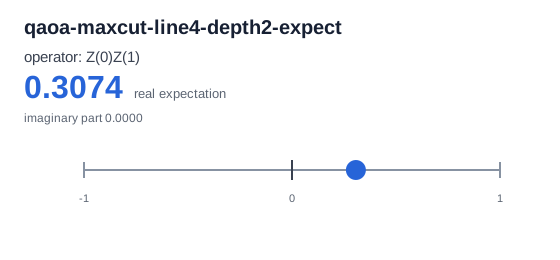
The result JSON reports expectation_value.re = 0.3074 and
expectation_value.im = 0.0. The imaginary part is zero by construction
— the expectation of a Hermitian operator on any state is real — and
Z(0)Z(1) is the Pauli product \( Z_0 \otimes Z_1 \) padded with
identities on qubits 2 and 3.
The sign of \( \langle Z_0 Z_1 \rangle \) tells you which way the trial state leans on edge \( (0, 1) \). A value near \( +1 \) means the two qubits are strongly correlated in the computational basis — partition-same, edge-uncut. A value near \( -1 \) means they are strongly anti-correlated — partition-split, edge-cut. For MaxCut we want each \( \langle Z_iZ_j \rangle \) close to \( -1 \).
Baseline check. The initial state \( |+\rangle^{\otimes 4} \) is a product of independent uniform bits, so every \( \langle Z_iZ_j \rangle \) on it is zero. The depth-2 block at \( \gamma = 0.1 \) and \( \beta = 0.3 \) pushes \( \langle Z_0 Z_1 \rangle \) to \( +0.307 \) — that is, away from the MaxCut optimum. The 4-vertex line has a unique MaxCut of value 3 (alternating assignment \( 0101 \) or \( 1010 \) cuts every edge), at which \( \langle H_C \rangle = 3 \) and each individual \( \langle Z_iZ_j \rangle = -1 \). The gap between \( +0.307 \) and \( -1 \) is what a proper parameter optimization would close; hand-picked angles have no reason to produce a useful cut, and indeed they do not.
This is a feature, not a bug: the QAOA ansatz is a generic parameterized state-preparation circuit whose cost landscape over \( (\boldsymbol\gamma, \boldsymbol\beta) \) is non-trivial, and finding the good valleys is the classical optimizer’s job. Seeing a bad value at a hand-picked point confirms the ansatz responds to its parameters.
Verifying correctness
The number above — \( \langle Z_0 Z_1\rangle = 0.307389\ldots \) — does
not match an obvious closed form, so checking it requires a second
simulator. scripts/reference_simulate.py is an independent numpy
state-vector implementation in ~80 lines; running it on the same circuit
JSON and computing the same Pauli operator must give the same value, to
within machine precision:
python3 scripts/reference_simulate.py \
    docs/src/examples/generated/circuits/qaoa-maxcut-line4-depth2.json \
    --op "Z(0)Z(1)"
Expected output:
{"expectation_value": {"re": 0.3073893020477073, "im": 0.0}}
The CLI result from the run above is 0.3073893020477075. The two
values differ by \( 2.8 \times 10^{-16} \) — one unit in the last
place of complex-double arithmetic — and the imaginary parts are
identically zero. Because the reference and the CLI agree to the bit
despite being independent implementations in different languages
(Python+numpy vs. Rust), the agreement pins down both the circuit
construction in the shell script and the matrix application in the
simulator. A bug in either would show up as a visible disagreement.
Variations & next steps
- Increase depth. Pass
3or4as the script’s first argument. Each extra layer adds one more \( (\gamma, \beta) \) pair and \( |E| \cdot 3 + n \) gates. Empirically, the optimized cost at larger \( p \) approaches the true MaxCut. - Change the graph. Edit the edge list in
examples/cli/qaoa_maxcut_line4.shto a ring \( (0,1), (1,2), (2,3), (3,0) \), a random graph, or any other topology. The CNOT-sandwich pattern adapts one edge at a time. - Full cost readout. Run
yao run --oponce per edge and sum the results via the identity \( \langle H_C\rangle = |E|/2 - \tfrac{1}{2}\sum \langle Z_iZ_j\rangle \). For this example’s three edges on the line-4 graph, evaluating \( \langle Z_0Z_1\rangle, \langle Z_1Z_2\rangle, \langle Z_2Z_3\rangle \) and summing recovers the full QAOA objective. - Parameter optimization (deferred). The classical outer loop — a
Nelder–Mead, SPSA, or parameter-shift gradient optimizer wrapped
around
yao run --op— is tracked in issue #313. - Related circuits. See Ancilla Protocols for the Hadamard test, a standard subroutine for evaluating Pauli expectations on a hardware register. For a different variational ansatz with a different loss function, see Quantum Circuit Born Machine.
References
-
E. Farhi, J. Goldstone, and S. Gutmann, “A Quantum Approximate Optimization Algorithm”, arXiv:1411.4028 (2014). ↩
-
M. X. Goemans and D. P. Williamson, “Improved approximation algorithms for maximum cut and satisfiability problems using semidefinite programming”, J. ACM 42, 1115 (1995); the randomized-rounding algorithm achieves expected cut \( \geq 0.87856 \cdot \mathrm{OPT} \). ↩
-
yao-rs issue #31, “Parameter-optimization loop for variational examples”. Tracks the planned training harness for QAOA and VQE-style workflows. ↩ ↩2