Grover Search
Amplify the marked item out of an unstructured database of \( N \) items in \( O(\sqrt{N}) \) oracle queries — two reflections compose to a rotation in a two-dimensional subspace and the marked amplitude grows.
Background
Grover introduced his search algorithm in 19961. The problem is unstructured search: given oracle access to a Boolean function \( f : {0, 1}^n \to {0, 1} \) with a single marked input \( w \) satisfying \( f(w) = 1 \), locate \( w \). Classically no strategy does better than \( \Theta(N) \) oracle queries on average, where \( N = 2^n \); Grover’s algorithm uses \( O(\sqrt{N}) \). This quadratic speedup is modest compared to the exponential gap in Bernstein–Vazirani, but it applies to a generic black-box predicate rather than to a promised-structured function, so it shows up as a subroutine far more often.
Applications include heuristic SAT solvers (Grover inside a branching search tree), collision-finding speedups, and amplitude estimation, which generalizes Grover by running phase estimation on the Grover iteration operator to count the marked inputs without finding one. The geometric picture — two reflections compose to a rotation in a two-dimensional subspace spanned by the marked and unmarked components — is what makes the algorithm memorable.
Nielsen and Chuang cover Grover’s algorithm in §6.12.
The math
Let \( N = 2^n \). The oracle takes two canonical forms. The bit oracle \( U_f|x\rangle|y\rangle = |x\rangle|y \oplus f(x)\rangle \) becomes, via the usual ancilla-in-\( |-\rangle \) trick, the phase oracle
$$ O,|x\rangle ;=; (-1)^{f(x)},|x\rangle. $$
\( O \) flips the sign of \( |w\rangle \) and leaves every other basis state alone.
Amplitude-amplification geometry. Define three states on the \( n \)-qubit register:
- \( |w\rangle \) — the marked state (one basis vector).
- \( |b\rangle = \tfrac{1}{\sqrt{N-1}}\sum_{x \ne w}|x\rangle \) — the uniform superposition over the \( N - 1 \) unmarked states.
- \( |s\rangle = H^{\otimes n}|0\rangle^{\otimes n} = \tfrac{1}{\sqrt{N}}\sum_{x}|x\rangle \) — the uniform superposition the algorithm starts in.
Decomposing \( |s\rangle \) in the orthonormal basis \( {|w\rangle, |b\rangle} \),
$$ |s\rangle ;=; \sin\theta,|w\rangle + \cos\theta,|b\rangle, \qquad \sin\theta ;=; \frac{1}{\sqrt{N}}. $$
Grover iteration = two reflections. The oracle \( O \) negates the \( |w\rangle \) component and fixes the \( |b\rangle \) component, so in the \( (|w\rangle, |b\rangle) \) plane it is the reflection across \( |b\rangle \). The diffusion operator
$$ D ;=; 2|s\rangle\langle s| - I ;=; H^{\otimes n},(2|0\rangle\langle 0| - I),H^{\otimes n} $$
is the reflection across \( |s\rangle \). A composition of two reflections with angle \( \theta \) between their axes is a rotation by \( 2\theta \) in the plane they span. Hence
$$ G ;=; D \cdot O $$
is a rotation by \( 2\theta \) in the \( (|w\rangle, |b\rangle) \) plane, directed toward \( |w\rangle \).
After \( k \) iterations the state lies at angle \( (2k+1)\theta \) from \( |b\rangle \):
$$ |\psi_k\rangle ;=; G^k|s\rangle ;=; \sin((2k+1)\theta),|w\rangle + \cos((2k+1)\theta),|b\rangle. $$
A measurement returns \( w \) with probability \( \sin^2((2k+1)\theta) \). The optimal number of iterations satisfies \( (2k+1)\theta \approx \pi/2 \), i.e.
$$ k_{\mathrm{opt}} ;\approx; \frac{\pi}{4\theta} - \frac{1}{2} ;\approx; \frac{\pi}{4}\sqrt{N}, $$
using \( \theta \approx \sin\theta = 1/\sqrt{N} \) for large \( N \). That square-root is the Grover speedup.
Concrete case. With \( n = 3 \), \( N = 8 \), one marked state, we have \( \sin\theta = 1/\sqrt{8} \approx 0.3536 \), so \( \theta \approx 0.3614 \) rad (20.7°) and \( k_{\mathrm{opt}} \approx \pi/(4 \cdot 0.3614) - 1/2 \approx 1.67 \). Rounding up to \( k = 2 \), the predicted success probability is
$$ \sin^2(5\theta) ;=; \sin^2(1.807) ;\approx; 0.9454. $$
Note that \( k = 3 \) would overshoot: the state rotates past \( |w\rangle \) and \( \sin^2(7\theta) = \sin^2(2.530) \approx 0.326 \). Grover is periodic — running the iteration forever does not help, the amplitude oscillates.
The circuit

Thirty-five elements on three qubits, for the marked basis index \( w = 5 \). The circuit has three stages:
- \( H^{\otimes 3} \) — three Hadamards preparing the uniform superposition \( |s\rangle \) from \( |0\rangle^{\otimes 3} \).
- Grover iteration 1: oracle \( O_w \), then diffusion \( D \).
- Grover iteration 2: identical oracle, identical diffusion.
Oracle for marked state 5. The integer 5 in binary, padded to three bits, is \( 101 \). Under the yao-rs bit-ordering convention (qubit 0 at the MSB) this is \( q_0 = 1,\ q_1 = 0,\ q_2 = 1 \), so the marked state is \( |w\rangle = |101\rangle \). The standard construction turns \( O_w \) into a fixed “mark-the-all-ones-string” operation by sandwiching it between \( X \) gates on every qubit whose marked bit is 0. In this case that is qubit 1 only. The all-ones phase flip itself is a multi- controlled \( Z \) with the last qubit as target and the remaining qubits as controls — a CCZ. In short,
$$ O_w ;=; X_1 \cdot \mathrm{CCZ}_{q_0, q_1 \to q_2} \cdot X_1. $$
Diffusion. The identity \( 2|s\rangle\langle s| - I = H^{\otimes n}(2|0\rangle\langle 0| - I)H^{\otimes n} \) lets us build \( D \) out of Hadamards and a mark-the-all-zeros phase flip. The all-zeros phase flip is the all-ones phase flip sandwiched by \( X^{\otimes n} \): every qubit’s 0 and 1 swap, so
$$ D ;=; H^{\otimes 3} \cdot X^{\otimes 3} \cdot \mathrm{CCZ}_{q_0, q_1 \to q_2} \cdot X^{\otimes 3} \cdot H^{\otimes 3}. $$
The CCZ is encoded as a Z gate on target [2] with controls: [0, 1];
the following JSON excerpt shows the initial Hadamard layer and the full
first Grover iteration (17 of 35 gates). The second iteration is
bit-for-bit identical. The format follows the
Circuit JSON Conventions:
{
  "num_qubits": 3,
  "elements": [
    {"type": "gate", "gate": "H", "targets": [0]},
    {"type": "gate", "gate": "H", "targets": [1]},
    {"type": "gate", "gate": "H", "targets": [2]},
    {"type": "gate", "gate": "X", "targets": [1]},
    {"type": "gate", "gate": "Z", "targets": [2], "controls": [0, 1]},
    {"type": "gate", "gate": "X", "targets": [1]},
    {"type": "gate", "gate": "H", "targets": [0]},
    {"type": "gate", "gate": "H", "targets": [1]},
    {"type": "gate", "gate": "H", "targets": [2]},
    {"type": "gate", "gate": "X", "targets": [0]},
    {"type": "gate", "gate": "X", "targets": [1]},
    {"type": "gate", "gate": "X", "targets": [2]},
    {"type": "gate", "gate": "Z", "targets": [2], "controls": [0, 1]},
    {"type": "gate", "gate": "X", "targets": [0]},
    {"type": "gate", "gate": "X", "targets": [1]},
    {"type": "gate", "gate": "X", "targets": [2]},
    {"type": "gate", "gate": "H", "targets": [0]}
  ]
}
Full Grover JSON (35 gates).
Bit ordering callout. The marked integer 5 reads \( 101_2 \), which in the qubit-0-MSB convention means \( q_0 = 1,\ q_1 = 0,\ q_2 = 1 \). That matches the oracle’s \( X \)-sandwich pattern: the \( X \) lands on qubit 1 precisely because \( q_1 \) is the only bit that is 0 in the marked state. See bit ordering for the full rule.
Running it
Quick run — download the Grover-for-5 circuit JSON and simulate:
yao simulate grover-marked-5.json | yao probs -
Expected output (peak at index 5, residual \( 0.0078 \) elsewhere):
{
  "locs": null,
  "num_qubits": 3,
  "probabilities": [
    0.007812500000000005,
    0.007812500000000016,
    0.007812500000000016,
    0.007812500000000005,
    0.007812500000000009,
    0.9453125000000014,
    0.007812500000000002,
    0.007812500000000002
  ]
}
Regenerating this page’s artifacts from the repo root:
cargo build -p yao-cli --no-default-features
YAO_ARTIFACT_DIR=docs/src/examples/generated YAO_BIN=target/debug/yao bash examples/cli/grover_marked_state.sh 5
python3 scripts/plot_cli_results.py docs/src/examples/generated/results docs/src/examples/generated/plots
Interpreting the result
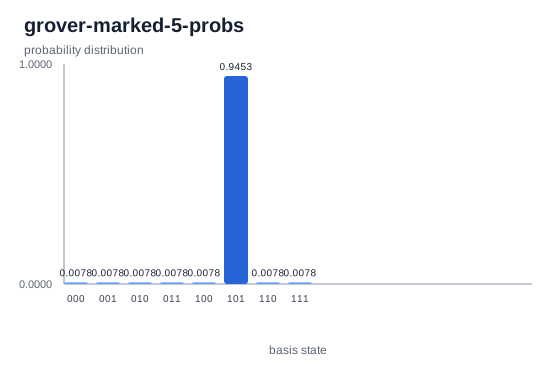
The probability array has probabilities[5] = 0.9453 and every other
entry \( \approx 0.0078 \). Under the qubit-0-MSB convention, index 5
is \( |q_0 q_1 q_2\rangle = |101\rangle \) — the marked state. The
remaining weight, \( 1 - 0.9453 \approx 0.0547 \), is spread evenly
over the seven unmarked indices: \( 0.0547 / 7 \approx 0.00781 \) each,
matching the observed value.
Compare to theory. Predicted peak probability after \( k = 2 \) iterations with \( N = 8 \) is
$$ \sin^2((2 \cdot 2 + 1)\theta) ;=; \sin^2(5 \cdot 0.3614) ;=; \sin^2(1.807) ;\approx; 0.9454. $$
Measured 0.9453, predicted 0.9454 — agreement to five decimals, with the residual one part in \( 10^5 \) attributable to float rounding in the arcsin and sine evaluations.
Two observations. First, \( 94.5% \) is not \( 100% \) and cannot be made so with this \( N \). The rotation angle \( 2\theta \) does not divide \( \pi \) exactly, so no integer number of iterations lands precisely on \( |w\rangle \); the closest approach at \( k = 2 \) overshoots \( \pi/2 \) by a small amount (\( 5\theta \approx 1.807 > \pi/2 \approx 1.571 \)), and the unmarked component \( \cos(5\theta) \) has size \( \sim 0.23 \). For larger \( N \) the angle \( \theta \) shrinks and the residual unmarked probability drops as \( O(1/N) \). Second, a third iteration would overshoot further: at \( k = 3 \) the state lies at angle \( 7\theta \approx 2.530 \), well past \( \pi/2 \), with \( \sin^2(7\theta) \approx 0.326 \) — worse than one iteration. Grover is not a “more is better” algorithm; the amplitude swings sinusoidally in the \( (|w\rangle, |b\rangle) \) plane and the right stopping time has to be computed in advance.
Variations & next steps
- Different marked states. Rerun the script with any \( \text{marked} \in {0, 1, \dots, 7} \); the peak moves but the oracle’s \( X \)-sandwich pattern adapts automatically to the new binary expansion, and the peak height stays \( \approx 0.9453 \).
- Different register size. Edit the script’s \( n \) and the iteration count. The theoretical optimum is \( \lfloor \pi / (4 \arcsin(1/\sqrt{N})) \rfloor \); for \( n = 4 \) that is \( \lfloor 3.14\ldots \rfloor = 3 \), for \( n = 6 \) it is \( 6 \), and the peak probability approaches 1 as \( N \) grows.
- Multiple marked states. If \( M \) of the \( N \) inputs satisfy \( f(x) = 1 \), the rotation angle becomes \( \theta = \arcsin(\sqrt{M/N}) \) and the optimal number of iterations shrinks to \( \approx \tfrac{\pi}{4}\sqrt{N/M} \); this and the tight constants on the success probability are worked out by Boyer, Brassard, Høyer, and Tapp3. Knowing \( M \) in advance matters; overshooting is easy.
- Amplitude estimation. Running phase estimation on the Grover iteration \( G \) recovers \( \theta \), hence \( M / N \), without ever identifying a specific marked input. See Phase Estimation for the readout block that slots in here.
- Compared to Bernstein–Vazirani — which uses the same H–oracle–H scaffold for a single-shot deterministic readout — Grover’s speedup is only quadratic. BV exploits a promise on \( f \) (it is linear over \( \mathbb{Z}_2 \)); Grover makes no such promise and so cannot beat \( \sqrt{N} \).
- Deferred. Variational Grover generators and structured oracles are tracked in issue #33.
References
-
L. K. Grover, “A fast quantum mechanical algorithm for database search”, in Proc. 28th Annual ACM Symposium on Theory of Computing (ACM, 1996), pp. 212–219; arXiv:quant-ph/9605043. ↩
-
M. A. Nielsen and I. L. Chuang, Quantum Computation and Quantum Information, 10th Anniversary Edition (Cambridge University Press, 2010), §6.1 (the quantum search algorithm). ↩
-
M. Boyer, G. Brassard, P. Høyer, and A. Tapp, “Tight bounds on quantum searching”, Fortschr. Phys. 46, 493 (1998); arXiv:quant-ph/9605034. ↩