Bernstein–Vazirani
Recover an unknown \( n \)-bit string from a single oracle query — the cleanest textbook demonstration that quantum algorithms can beat the classical query lower bound.
Background
Bernstein and Vazirani posed the following puzzle in 19931. You are given oracle access to a function \( f : {0, 1}^n \to {0, 1} \) that is guaranteed to have the form \( f(x) = s \cdot x \bmod 2 \) for some fixed but unknown bitstring \( s \in {0, 1}^n \), where \( s \cdot x = \sum_i s_i x_i \) is the bitwise inner product. The goal is to recover \( s \). Classically, you need \( n \) oracle queries — query \( f \) on each standard basis vector \( e_i \) to read off one bit of \( s \) at a time, and any adaptive strategy that uses fewer queries must misidentify \( s \) on some instance. The Bernstein–Vazirani (BV) algorithm uses one oracle query.
One query is the minimum possible, so BV is optimal and the classical-quantum gap is exactly a factor of \( n \). Compared to Shor and HHL this is a modest speedup, but BV is often the first concrete superpolynomial separation one can walk through by hand: no QFT, no phase-estimation ladder, no eigenstate preparation. All it takes is a layer of Hadamards, a layer of single-qubit \( Z \) gates, and another layer of Hadamards. The construction also scales to textbook-length for any \( n \), so it doubles as a stress test for frameworks and a teaching example. Nielsen and Chuang discuss the algorithm in §1.4.42.
The math
The standard presentation uses a bit-XOR oracle \( U_f|x\rangle|y\rangle = |x\rangle|y \oplus f(x)\rangle \) on an \( n \)-qubit input register plus a one-qubit ancilla \( y \). A standard trick initializes the ancilla in \( |-\rangle = (|0\rangle - |1\rangle)/\sqrt{2} \). Then
$$ U_f,|x\rangle|-\rangle ;=; |x\rangle \otimes \tfrac{1}{\sqrt{2}}\bigl(|f(x)\rangle - |1 \oplus f(x)\rangle\bigr) ;=; (-1)^{f(x)},|x\rangle|-\rangle. $$
The ancilla is unchanged; its only job was to convert the bit-flip oracle into a phase oracle \( O_f : |x\rangle \mapsto (-1)^{f(x)}|x\rangle \) on the input register. From here on we fold the ancilla away and work only with the \( n \)-qubit input register and the phase oracle \( O_f \).
Phase oracle decomposition. Because \( s \cdot x \bmod 2 = \sum_i s_i x_i \bmod 2 \) and the phase \( -1 \) is multiplicative,
$$ O_f ;=; \prod_{i : s_i = 1} Z_i. $$
Each \( Z_i \) is the single-qubit Pauli \( Z = \operatorname{diag}(1, -1) \) acting on qubit \( i \); it contributes a phase \( (-1)^{x_i} \) on the \( |1\rangle \) branch of qubit \( i \), so qubits with \( s_i = 1 \) pick up a \( (-1)^{s_i x_i} \) factor and qubits with \( s_i = 0 \) pick up no phase. The oracle is thus a trivial product of single-qubit \( Z \) gates once the secret is known. The point of BV is that we can discover the secret in one query.
Full algorithm. Starting from \( |0\rangle^{\otimes n} \) and applying \( H^{\otimes n} \) creates the uniform superposition. Applying the phase oracle attaches a sign \( (-1)^{s \cdot x} \) to each basis term:
$$ |0\rangle^{\otimes n} ;\xrightarrow{H^{\otimes n}}; \frac{1}{\sqrt{2^n}}\sum_x |x\rangle ;\xrightarrow{O_f}; \frac{1}{\sqrt{2^n}}\sum_x (-1)^{s \cdot x},|x\rangle. $$
A second layer of Hadamards performs the readout. The identity \( H^{\otimes n}|x\rangle = 2^{-n/2}\sum_y (-1)^{x \cdot y}|y\rangle \) turns the state into
$$ \frac{1}{2^n}\sum_{x, y} (-1)^{x \cdot (s \oplus y)},|y\rangle. $$
The inner sum over \( x \) of \( (-1)^{x \cdot t} \) equals \( 2^n \) when \( t = 0 \) and zero otherwise — the orthogonality of characters of \( \mathbb{Z}_2^n \). So every \( y \neq s \) cancels, and the double sum collapses to
$$ \sum_y \delta_{y, s},|y\rangle ;=; |s\rangle. $$
One measurement returns \( s \) with certainty.
Query complexity. One oracle call suffices because the Hadamard-wrapped phase oracle is a Fourier-style readout. The uniform superposition broadcasts \( x \) across every classical input at once; the oracle writes \( s \) into the phases; the final Hadamards invert the superposition and concentrate all amplitude on \( |s\rangle \). Every bit of \( s \) is read in parallel.
The circuit
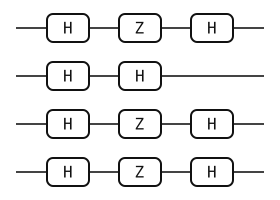
Eleven elements on four qubits, for the secret \( s = 1011 \). The phase oracle is \( Z_0 Z_2 Z_3 \): there is a \( Z \) on each qubit whose secret bit is \( 1 \), and no \( Z \) on qubit 1 because \( s_1 = 0 \). Reading left-to-right, the circuit has three phases:
- \( H^{\otimes 4} \) — four Hadamards, one per qubit, building the uniform superposition from \( |0\rangle^{\otimes 4} \).
- \( Z_0 Z_2 Z_3 \) — the phase oracle for \( s = 1011 \). The script indexes the secret string left-to-right as qubit 0 through qubit \( n-1 \) (so \( s_0 = 1,\ s_1 = 0,\ s_2 = 1,\ s_3 = 1 \)) and appends a \( Z \) on exactly the qubits whose secret bit is \( 1 \).
- \( H^{\otimes 4} \) — the inverse Hadamard layer that performs the readout. \( H \) is self-inverse, so the same layer of Hadamards that built the superposition is the one that collapses it.
The full circuit JSON follows the Circuit JSON Conventions:
{
  "num_qubits": 4,
  "elements": [
    {"type": "gate", "gate": "H", "targets": [0]},
    {"type": "gate", "gate": "H", "targets": [1]},
    {"type": "gate", "gate": "H", "targets": [2]},
    {"type": "gate", "gate": "H", "targets": [3]},
    {"type": "gate", "gate": "Z", "targets": [0]},
    {"type": "gate", "gate": "Z", "targets": [2]},
    {"type": "gate", "gate": "Z", "targets": [3]},
    {"type": "gate", "gate": "H", "targets": [0]},
    {"type": "gate", "gate": "H", "targets": [1]},
    {"type": "gate", "gate": "H", "targets": [2]},
    {"type": "gate", "gate": "H", "targets": [3]}
  ]
}
Bit ordering callout. In yao-rs, qubit 0 is the most significant bit of the probability-array index:
probabilities[k]corresponds to \( |q_0 q_1 q_2 q_3\rangle \) with \( q_0 \) written at the left. The script’s secret-string convention also treats position 0 as the leftmost character, so reading the measured index as a 4-bit binary string gives back the secret character-for-character. See bit ordering for the full rule.
Running it
Quick run — download the BV-1011 circuit JSON and simulate:
yao simulate bernstein-vazirani-1011.json | yao probs -
Expected output (single non-zero entry at index 11, binary 1011):
{
  "locs": null,
  "num_qubits": 4,
  "probabilities": [
    0.0, 0.0, 0.0, 0.0,
    0.0, 0.0, 0.0, 0.0,
    0.0, 0.0, 0.0, 1.0000000000000004,
    0.0, 0.0, 0.0, 0.0
  ]
}
Regenerating this page’s artifacts from the repo root:
cargo build -p yao-cli --no-default-features
YAO_ARTIFACT_DIR=docs/src/examples/generated YAO_BIN=target/debug/yao bash examples/cli/bernstein_vazirani.sh 1011
python3 scripts/plot_cli_results.py docs/src/examples/generated/results docs/src/examples/generated/plots
Interpreting the result
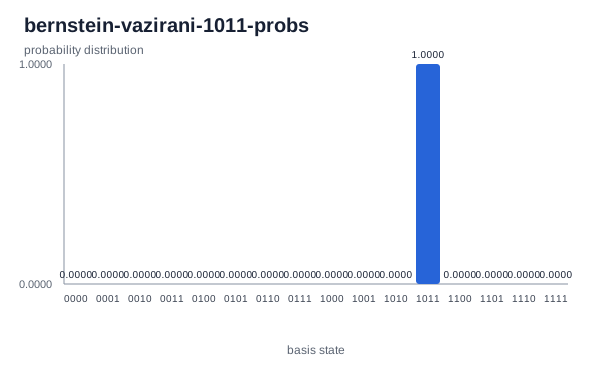
The probability array has a single non-zero entry: probabilities[11] = 1,
every other entry is zero. Under the qubit-0-MSB convention, index 11 is the
basis state \( |q_0 q_1 q_2 q_3\rangle = |1011\rangle \). Writing the index
out,
$$ 11 ;=; 8 + 0 + 2 + 1 ;=; q_0 \cdot 2^3 + q_1 \cdot 2^2 + q_2 \cdot 2^1 + q_3 \cdot 2^0, $$
so \( q_0 = 1,\ q_1 = 0,\ q_2 = 1,\ q_3 = 1 \). The four qubit values read in order are exactly the four characters of the secret string “1011”. This is the alignment the convention buys you: the script indexes the secret left-to-right as qubits 0 through \( n-1 \), and yao-rs indexes the basis state left-to-right with qubit 0 as the MSB, so “read index 11 as a 4-bit binary number” and “read the secret” are the same operation.
Two things are worth naming. First, the outcome is deterministic — one shot, probability 1, no majority vote required. Classical algorithms need \( n \) oracle queries on average to pin down the last bit; BV needs exactly one, and the answer appears as a sharp peak in the probability distribution. Second, the peak is concentrated because the final Hadamard layer implements an exact Fourier inversion over \( \mathbb{Z}_2^n \); any other measurement basis would scatter amplitude across multiple outcomes and require more shots to decode.
Variations & next steps
- Different secrets. Run the shell script with any bitstring of any
length, up to the CLI’s practical qubit limit:
bash examples/cli/bernstein_vazirani.sh 110100. The probability should always concentrate on the index whose \( n \)-bit binary expansion matches the secret character-for-character. - Simon’s algorithm generalizes BV from a hidden linear function over \( \mathbb{Z}_2 \) to a hidden period (issue #34 tracks richer oracle examples). The speedup becomes exponential rather than linear.
- Deutsch–Jozsa solves the constant-vs-balanced decision problem with the same H–oracle–H scaffold in one query; conceptually the same family and a good companion exercise.
- Cross-links: Grover Search is a different oracle-driven algorithm that uses amplitude amplification rather than a Fourier-style readout, and Entangled States covers the Hadamard-fan preparation step that underlies this algorithm’s uniform-superposition stage.
References
-
E. Bernstein and U. Vazirani, “Quantum complexity theory”, in Proc. 25th Annual ACM Symposium on Theory of Computing (ACM, 1993), pp. 11–20; full version SIAM J. Comput. 26, 1411 (1997). ↩
-
M. A. Nielsen and I. L. Chuang, Quantum Computation and Quantum Information, 10th Anniversary Edition (Cambridge University Press, 2010), §1.4.4 (the Bernstein–Vazirani algorithm). ↩