Ancilla Protocols
Two short circuits — the Hadamard test and the swap test — both follow the same ancilla-plus-controlled-\( U \) recipe, and both encode the answer in a single ancilla marginal.
Background
The Hadamard test and the swap test share a single template. Put one ancilla qubit in \( |+\rangle \), apply a unitary controlled by that ancilla, Hadamard the ancilla again, and measure it. Because the controlled unitary entangles the phase of \( U \) with the ancilla and the final Hadamard converts that phase into a computational-basis bit, the ancilla marginal encodes a specific matrix element or overlap. Two instances of the template give two canonical subroutines.
The Hadamard test estimates \( \mathrm{Re},\langle\psi|U|\psi\rangle \) for a given unitary \( U \) and state \( |\psi\rangle \); prepending an \( S \) gate to the ancilla swaps the real part for the imaginary part. It appears as the inner loop of many variational eigensolvers, where the quantity being estimated is \( \langle\psi|H|\psi\rangle \) for a Hamiltonian term \( H \) decomposed into unitaries.
The swap test specializes the template with \( U = \mathrm{SWAP}_{AB} \) acting on two copies of prepared states \( |\phi\rangle, |\psi\rangle \) and returns the overlap \( |\langle\phi|\psi\rangle|^2 \). It is the standard fidelity estimator and a useful proxy for several classical-shadow protocols.
There is a tight connection to Phase Estimation: the Hadamard test is precisely one-bit phase estimation on \( U \) restricted to an input state \( |\psi\rangle \). When \( |\psi\rangle \) happens to be an eigenstate whose eigenphase is dyadic, the two circuits coincide gate-for-gate.
Hadamard test: Nielsen and Chuang Exercise 5.261; swap test: Buhrman, Cleve, Watrous, and de Wolf2.
The math
Derive the Hadamard test first. Start with ancilla \( |0\rangle \) and system \( |\psi\rangle \), then apply \( H \) to the ancilla:
$$ |0\rangle|\psi\rangle ;\xrightarrow{H_0}; \tfrac{1}{\sqrt{2}}(|0\rangle + |1\rangle) \otimes |\psi\rangle. $$
The controlled-\( U \) leaves the \( |0\rangle \) branch alone and sends the \( |1\rangle \) branch to \( |1\rangle \otimes U|\psi\rangle \):
$$ \tfrac{1}{\sqrt{2}}\bigl(|0\rangle|\psi\rangle + |1\rangle,U|\psi\rangle\bigr). $$
A second Hadamard on the ancilla expands this to
$$ \tfrac{1}{2}\Bigl(|0\rangle(|\psi\rangle + U|\psi\rangle) + |1\rangle(|\psi\rangle - U|\psi\rangle)\Bigr). $$
The ancilla-\( 0 \) marginal probability is therefore
$$ P(0) ;=; \tfrac{1}{4}\bigl||\psi\rangle + U|\psi\rangle\bigr|^2 ;=; \tfrac{1}{2}\bigl(1 + \mathrm{Re},\langle\psi|U|\psi\rangle\bigr), $$
and \( P(1) = \tfrac{1}{2}(1 - \mathrm{Re},\langle\psi|U|\psi\rangle) \). The difference \( P(0) - P(1) = \mathrm{Re},\langle\psi|U|\psi\rangle \) is the observable that sampling the ancilla estimates directly. For the imaginary part, replace the first \( H \) on the ancilla by \( SH \): this prepares \( (|0\rangle + i|1\rangle)/\sqrt{2} \) instead, and the same derivation now gives \( P(0) - P(1) = \mathrm{Im},\langle\psi|U|\psi\rangle \).
The swap test is the specialization with two registers and \( U = \mathrm{SWAP}_{AB} \). Prepare registers \( A \) and \( B \) in \( |\phi\rangle \) and \( |\psi\rangle \); prepare the ancilla in \( |+\rangle \); apply controlled-SWAP; apply \( H \) to the ancilla. The same identity gives
$$ P(0) ;=; \tfrac{1}{2}\bigl(1 + \mathrm{Re},\langle\phi|\langle\psi|,\mathrm{SWAP},|\phi\rangle|\psi\rangle\bigr). $$
The SWAP matrix element evaluates as \( \langle\phi|\langle\psi|,\mathrm{SWAP},|\phi\rangle|\psi\rangle = \langle\phi|\psi\rangle\langle\psi|\phi\rangle = |\langle\phi|\psi\rangle|^2 \), which is real and non-negative, so the real-part wrapper is redundant and
$$ P(\text{ancilla}=0) ;=; \tfrac{1}{2}\bigl(1 + |\langle\phi|\psi\rangle|^2\bigr). $$
Sampling \( P(\text{ancilla}=0) \) and inverting gives the squared overlap.
Ancilla marginals. When the system register holds more than one qubit, the full measurement distribution has structure beyond the ancilla bit. What the protocol promises is a statement about the ancilla marginal — the distribution obtained by summing out the system register. In the swap-test example below, the 8-dimensional probability array has four equal-weight entries of \( 0.25 \), yet the ancilla marginal cleanly reports \( P(0) = 1/2 \). In general, one computes the ancilla marginal from the full probability vector by summing over all basis indices whose ancilla bit matches the desired outcome.
The circuits
Hadamard test Z
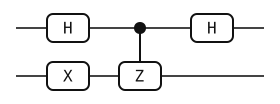
Four elements on two qubits. Qubit 0 is the ancilla; qubit 1 carries the input state. The circuit JSON follows the Circuit JSON Conventions:
{
  "num_qubits": 2,
  "elements": [
    {"type": "gate", "gate": "X", "targets": [1]},
    {"type": "gate", "gate": "H", "targets": [0]},
    {"type": "gate", "gate": "Z", "targets": [1], "controls": [0]},
    {"type": "gate", "gate": "H", "targets": [0]}
  ]
}
Full Hadamard-test JSON. The
gates map directly onto the template: X on q1 prepares the input
\( |\psi\rangle = |1\rangle \); the first H on q0 puts the ancilla in
\( |+\rangle \); the controlled Z is the controlled-\( U \) step with
\( U = Z \); the second H on q0 is the readout.
These are exactly the four gates of the Phase Estimation example, and that coincidence is the point. One-bit phase estimation on \( U = Z \) with eigenstate \( |1\rangle \) reads off the eigenphase \( \varphi = 1/2 \). The Hadamard test with the same inputs reads off \( \mathrm{Re},\langle 1|Z|1\rangle = -1 \). Both read the ancilla and get the bit \( 1 \). The circuit is identical — what differs is the interpretation.
Swap test
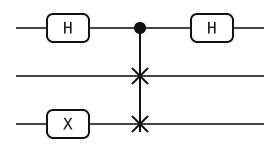
Four elements on three qubits. Qubit 0 is the ancilla; qubit 1 is register \( A \); qubit 2 is register \( B \). JSON:
{
  "num_qubits": 3,
  "elements": [
    {"type": "gate", "gate": "X", "targets": [2]},
    {"type": "gate", "gate": "H", "targets": [0]},
    {"type": "gate", "gate": "SWAP", "targets": [1, 2], "controls": [0]},
    {"type": "gate", "gate": "H", "targets": [0]}
  ]
}
Full swap-test JSON. The X on q2
prepares \( |\psi\rangle = |1\rangle \) on register \( B \); register
\( A \) stays in \( |\phi\rangle = |0\rangle \). The first H on q0
places the ancilla in \( |+\rangle \); the controlled SWAP swaps
\( A \) and \( B \) when the ancilla is \( |1\rangle \); the final
H reads out.
Bit ordering callout. In yao-rs, qubit 0 is the most significant bit of the index. The 8-entry probability array below indexes basis states \( |q_0 q_1 q_2\rangle \) with \( q_0 \) — the ancilla — at the left. Indices \( 0, 1, 2, 3 \) are the outcomes with ancilla \( = 0 \); indices \( 4, 5, 6, 7 \) are the outcomes with ancilla \( = 1 \). See bit ordering.
Running it
Quick run — download the circuit JSONs (Hadamard test, swap test) and simulate each:
yao simulate hadamard-test-z.json | yao probs -
yao simulate swap-test.json | yao probs -
Expected output for Hadamard test (deterministic \( |11\rangle \)):
{
  "locs": null,
  "num_qubits": 2,
  "probabilities": [0.0, 0.0, 0.0, 1.0000000000000004]
}
Expected output for swap test (four equal non-zero entries of \( 0.25 \)):
{
  "locs": null,
  "num_qubits": 3,
  "probabilities": [
    0.0, 0.2500000000000001, 0.2500000000000001, 0.0,
    0.0, 0.2500000000000001, 0.2500000000000001, 0.0
  ]
}
Regenerating this page’s artifacts from the repo root:
cargo build -p yao-cli --no-default-features
YAO_ARTIFACT_DIR=docs/src/examples/generated YAO_BIN=target/debug/yao bash examples/cli/hadamard_test_z.sh
YAO_ARTIFACT_DIR=docs/src/examples/generated YAO_BIN=target/debug/yao bash examples/cli/swap_test.sh
python3 scripts/plot_cli_results.py docs/src/examples/generated/results docs/src/examples/generated/plots
Interpreting the result
Hadamard test result
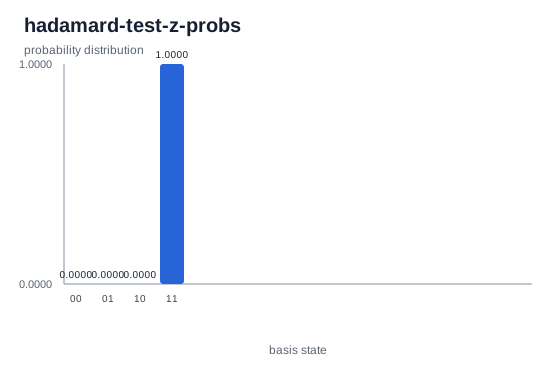
The probability array is [0, 0, 0, 1]: deterministic outcome
\( |q_0 q_1\rangle = |11\rangle \). Split by register: the ancilla
\( q_0 = 1 \) and the input register \( q_1 = 1 \) (unchanged, as the
eigenstate should be). Apply the Hadamard test identity:
$$ P(0) - P(1) ;=; 0 - 1 ;=; -1 ;=; \mathrm{Re},\langle 1|Z|1\rangle, $$
since \( Z|1\rangle = -|1\rangle \). This is an eigenstate case; the ancilla marginal is sharp.
Swap test result
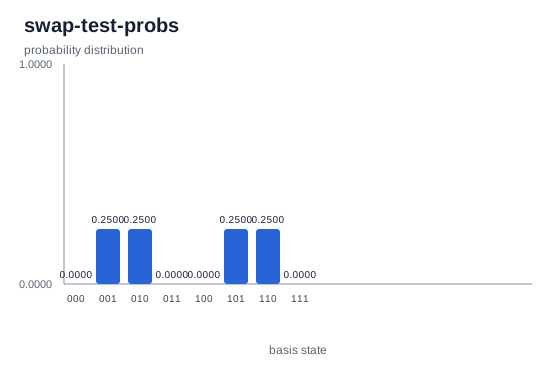
The probability array is [0, 0.25, 0.25, 0, 0, 0.25, 0.25, 0]. Four
non-zero entries of equal weight — not the sharp concentration the
eigenstate Hadamard test produced. Extract the ancilla marginal by summing
over indices whose top bit (qubit 0) is zero. Those indices are
\( 0, 1, 2, 3 \), with probabilities \( 0, 0.25, 0.25, 0 \), summing to
$$ P(\text{ancilla}=0) ;=; 0.5. $$
Matching the swap-test identity: \( \tfrac{1}{2}(1 + |\langle 0|1\rangle|^2) = \tfrac{1}{2}(1 + 0) = 1/2 \). ✓ The ancilla gets no information about \( {|\phi\rangle, |\psi\rangle} \) because those states are orthogonal.
The four-entry spread in the full distribution is a statement about the system register, not the ancilla. Conditioned on ancilla = 0 or ancilla = 1, the two-register marginal is an equal-weight mixture of \( |01\rangle \) and \( |10\rangle \) — the states produced by the SWAP acting or not acting on the distinguishable input \( |\phi\rangle_A|\psi\rangle_B = |01\rangle \). The controlled-SWAP has entangled the ancilla with the register, producing a Bell-like state across the two subsystems. The system register carries which-way information that the ancilla marginal discards.
Variations & next steps
- Imaginary part. Insert an \( S \) gate on the ancilla immediately after the first \( H \) to turn the Hadamard test into an estimator of \( \mathrm{Im},\langle\psi|U|\psi\rangle \).
- General overlaps. Prepare \( |\phi\rangle \) and \( |\psi\rangle \) on the two registers with arbitrary state-prep circuits; the swap test then estimates \( |\langle\phi|\psi\rangle|^2 \) for arbitrary prepared states. This is the workhorse fidelity estimator for quantum learning and verification.
- Expectation values inside variational algorithms. See QAOA MaxCut for a problem whose objective is a sum of Pauli expectation values; Hadamard-test subroutines are one standard way to measure each term. Variational eigensolvers (issue #31) follow the same pattern.
- Phase estimation connection. See Phase Estimation for the one-bit QPE circuit, which on this input is gate-for-gate the Hadamard test.
- Deferred. Classical shadows estimate many overlaps at once with a different sampling strategy and are not in this catalogue.