Phase Estimation
Extract the eigenphase of a unitary with an ancilla register, a controlled-\( U \) ladder, and an inverse QFT readout — the subroutine at the heart of Shor, HHL, and ground-state energy estimation.
Background
Quantum phase estimation (QPE) solves the following problem. Given a unitary \( U \) and an eigenstate \( |\psi\rangle \) with \( U|\psi\rangle = e^{2\pi i \varphi}|\psi\rangle \) for some \( \varphi \in [0, 1) \), produce an approximation of \( \varphi \) to \( t \) bits of precision. It is the central subroutine in Shor’s factoring algorithm, in HHL linear solving, and in ground-state energy estimation for quantum chemistry: every one of those algorithms ultimately converts a physically interesting quantity into an eigenphase and reads it out with QPE.
Kitaev introduced the algorithm in 19951; the polished “ancilla register + inverse QFT” form we use today is due to Cleve, Ekert, Macchiavello, and Mosca2. Nielsen and Chuang cover it in §5.23.
The example on this page is the smallest non-trivial case: one ancilla qubit estimating the eigenphase of \( Z \) on its \( -1 \)-eigenstate \( |1\rangle \). With \( t = 1 \) ancilla bit the inverse QFT collapses to a single Hadamard, so the whole algorithm fits in four gates — and every step of the general recipe remains visible.
The math
Fix a unitary \( U \) and an eigenstate \( |\psi\rangle \) with eigenphase \( \varphi \). Use \( t \) ancilla qubits (the “counting register”) together with the eigenstate on a separate register.
Step 1. Initialize the ancilla to \( |0\rangle^{\otimes t} \) and apply \( H^{\otimes t} \):
$$ |0\rangle^{\otimes t} ;\longmapsto; \frac{1}{\sqrt{2^t}} \sum_{k=0}^{2^t - 1} |k\rangle. $$
Step 2. For \( j = 0, 1, \dots, t-1 \), apply \( U^{2^j} \) to the eigenstate register conditioned on ancilla qubit \( j \) being \( |1\rangle \). Each controlled \( U^{2^j} \) leaves \( |\psi\rangle \) unchanged up to a global phase \( e^{2\pi i \varphi \cdot 2^j} \), and kickback puts that phase on the \( |1\rangle \) branch of the control ancilla. Summing over the \( t \) ancillae, the joint state becomes
$$ \frac{1}{\sqrt{2^t}} \sum_{k=0}^{2^t - 1} e^{2\pi i \varphi k},|k\rangle ;\otimes; |\psi\rangle. $$
The eigenstate is unchanged; the ancilla register now carries \( \varphi \) in its Fourier amplitudes.
Step 3. Apply the inverse QFT to the ancilla. By the definition of the QFT, if \( \varphi = m / 2^t \) for some integer \( m \) then the inverse QFT maps the Fourier-encoded state back to the computational basis state \( |m\rangle \), and measurement returns the binary expansion of \( \varphi \) with certainty. For generic \( \varphi \) the output peaks at \( \lfloor 2^t \varphi \rceil \) with width \( \sim 1/2^t \), so the measured bitstring is the best \( t \)-bit approximation of \( \varphi \) with high probability.
Precision trade. One additional ancilla bit doubles the resolution of \( \varphi \) but requires one further controlled application with the highest power \( U^{2^{t-1}} \). You trade circuit depth (larger \( U \) powers) for output precision.
The worked case \( t = 1 \), \( U = Z \). The \( -1 \)-eigenstate of \( Z \) is \( |1\rangle \): since \( Z|1\rangle = -|1\rangle = e^{i\pi}|1\rangle \), the eigenphase is \( \varphi = 1/2 \). With \( t = 1 \) the algorithm needs only one controlled application (\( U^{2^0} = U \), no higher powers) and the inverse QFT on a single qubit is literally \( H \). Tracing the state:
$$ |0\rangle|1\rangle \xrightarrow{H_0} \frac{|0\rangle + |1\rangle}{\sqrt{2}},|1\rangle \xrightarrow{\text{C-}Z} \frac{|0\rangle - |1\rangle}{\sqrt{2}},|1\rangle = |{-}\rangle,|1\rangle \xrightarrow{H_0} |1\rangle|1\rangle. $$
The final Hadamard maps \( |-\rangle \to |1\rangle \) deterministically; the ancilla reads \( 1 \), which is the single-bit binary expansion \( 0.1_\text{binary} = 1/2 = \varphi \). The eigenstate \( |1\rangle \) stays put, as it should.
The circuit
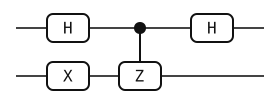
Four elements on two qubits. Qubit 0 is the ancilla; qubit 1 holds the eigenstate. The JSON follows the Circuit JSON Conventions:
{
  "num_qubits": 2,
  "elements": [
    {"type": "gate", "gate": "X", "targets": [1]},
    {"type": "gate", "gate": "H", "targets": [0]},
    {"type": "gate", "gate": "Z", "targets": [1], "controls": [0]},
    {"type": "gate", "gate": "H", "targets": [0]}
  ]
}
Map each gate back to a step of the general algorithm:
Xon q1 prepares the eigenstate \( |1\rangle \). This replaces the “start with \( |\psi\rangle \) in the system register” assumption that the general algorithm takes for granted.Hon q0 is the \( t = 1 \) case of \( H^{\otimes t} \); it puts the ancilla in \( |+\rangle \).- Controlled-
Zwith control q0, target q1 applies \( U^{2^0} = Z \) to the eigenstate when the ancilla is \( |1\rangle \). Eigenphase kickback puts the phase \( -1 \) on the \( |1\rangle \) branch of q0, turning \( |+\rangle \) into \( |-\rangle \). Hon q0 is the inverse QFT on a single qubit (QFT\(_1\) and its inverse are both \( H \)), converting the phase difference into a computational-basis bit.
Full phase-estimation circuit JSON.
Bit ordering callout. In yao-rs, qubit 0 is the most significant bit of the index. On this circuit the ancilla is q0 and the eigenstate register is q1, so in \( |q_0 q_1\rangle \) notation the left bit is the ancilla that carries the answer and the right bit is the system register. See bit ordering for the convention.
Running it
Quick run — download the
phase-estimation circuit JSON,
then (with yao on PATH):
yao simulate phase-estimation-z.json | yao probs -
Expected output:
{
  "locs": null,
  "num_qubits": 2,
  "probabilities": [
    0.0,
    0.0,
    0.0,
    1.0000000000000004
  ]
}
Regenerating this page’s artifacts from the repo root (via the bundled shell workflow):
cargo build -p yao-cli --no-default-features
YAO_ARTIFACT_DIR=docs/src/examples/generated YAO_BIN=target/debug/yao bash examples/cli/phase_estimation_z.sh
python3 scripts/plot_cli_results.py docs/src/examples/generated/results docs/src/examples/generated/plots
Interpreting the result
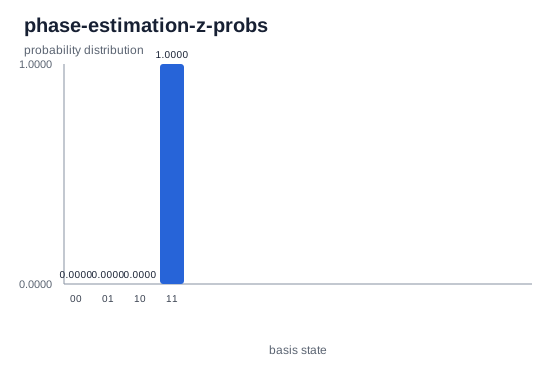
The probability array is [0, 0, 0, 1]. All weight sits on index 3, which in
the qubit-0-MSB convention is \( |q_0 q_1\rangle = |11\rangle \): the
ancilla \( q_0 = 1 \) and the system register \( q_1 = 1 \). Reading the
two bits separately gives exactly what the algorithm promises.
- \( q_0 = 1 \) is the single-bit binary expansion of the eigenphase: \( \varphi = 0.1_\text{binary} = 1/2 \). This is the estimate produced by the ancilla register.
- \( q_1 = 1 \) is the eigenstate \( |1\rangle \), preserved by the controlled-\( U \) step (QPE never disturbs the eigenstate — only kicks its phase onto the ancilla).
Connecting back to the general algorithm: with \( t = 1 \) the ancilla can only resolve \( \varphi \) to within \( 1/2 \) — it distinguishes the half-plane \( \varphi \in [1/4, 3/4) \) (bit \( 1 \)) from the complement \( [0, 1/4) \cup [3/4, 1) \) (bit \( 0 \)). The eigenphase of \( Z \) lands exactly on \( 1/2 \), the midpoint of the “bit \( 1 \)” range, and happens to be a dyadic fraction \( m / 2^t \) with \( t = 1, m = 1 \), so the inverse QFT returns \( |1\rangle \) deterministically.
For a \( \varphi \) that is not a dyadic fraction \( m / 2^t \), the deterministic peak spreads into a distribution over ancilla outcomes with weight concentrated near \( \lfloor 2^t \varphi \rceil \) and tails that decay as \( 1/k^2 \) in the distance from the peak. To sharpen a blurred estimate one either adds ancilla bits (doubling resolution per bit) or runs the algorithm multiple times and majority-votes the high-order bits. Tracked for later expansion in issue #32.
Variations & next steps
- More ancilla bits. The natural follow-up is full \( t \)-bit QPE on a general \( U \): \( t \) ancilla qubits, controlled \( U^{2^j} \) for \( j = 0, \dots, t-1 \), and an inverse QFT over the ancilla register. The four-gate example on this page is the \( t = 1 \) special case.
- Other unitaries. Any single-qubit unitary with an eigenphase that is a dyadic fraction admits an exact QPE with the right number of ancilla bits; for example, the T gate has eigenphase \( 1/8 \) and is resolved exactly with \( t = 3 \).
- The QFT subroutine. See Quantum Fourier Transform for the block that performs the Fourier encoding and its inverse — this is the stage that converts phase information into a measurable bitstring.
- One-ancilla expectation values. See Ancilla Protocols for the closely related Hadamard-test pattern: one ancilla, controlled-\( U \), Hadamard, and the ancilla’s expectation value reads off \( \text{Re},\langle\psi|U|\psi\rangle \). The \( t = 1 \) QPE above is the special case where \( |\psi\rangle \) is an eigenstate.
- Deferred. HHL and Shor build on QPE (see issue #32 for time-evolution oracles and issue #35 for the modular-arithmetic oracles that Shor needs).
References
-
A. Y. Kitaev, “Quantum measurements and the Abelian stabilizer problem”, arXiv:quant-ph/9511026 (1995). ↩
-
R. Cleve, A. Ekert, C. Macchiavello, and M. Mosca, “Quantum algorithms revisited”, Proc. R. Soc. A 454, 339 (1998). ↩
-
M. A. Nielsen and I. L. Chuang, Quantum Computation and Quantum Information, 10th Anniversary Edition (Cambridge University Press, 2010), §5.2 (phase estimation). ↩