Entangled States
Build the Bell pair and its n-qubit cousin the GHZ state, and see why their correlations have no product-state factorization.
Background
An n-qubit pure state \( |\psi\rangle \) is separable across a bipartition \( A|B \) if it factors as \( |\psi_A\rangle \otimes |\psi_B\rangle \). Otherwise it is entangled across that cut. A state that is entangled across every non-trivial bipartition is called genuinely multipartite entangled. Entanglement is the resource that separates quantum computing from a probabilistic classical register: classical correlations always factor once you condition on enough shared randomness; quantum correlations do not.
The two-qubit Bell pair \( |\Phi^+\rangle = (|00\rangle + |11\rangle)/\sqrt{2} \) is the oldest worked example. Einstein, Podolsky, and Rosen used it in 1935 to argue quantum mechanics had to be incomplete1. Bell turned that argument around in 1964 by deriving inequalities that any local-hidden-variable theory must satisfy and that \( |\Phi^+\rangle \) violates2. Greenberger, Horne, and Zeilinger generalized the argument in 1989 to three qubits with a state that violates local realism with certainty rather than statistically3. The n-qubit generalization of their state — the GHZ state — is the natural “fan” circuit built on top of a Bell pair.
Nielsen and Chuang cover this material in §1.3.6 and §2.34.
The math
Write \( |0\rangle = \binom{1}{0} \) and \( |1\rangle = \binom{0}{1} \). The Hadamard and controlled-NOT matrices we need are
$$ H = \tfrac{1}{\sqrt{2}}\begin{pmatrix} 1 & 1 \\ 1 & -1 \end{pmatrix}, \qquad \text{CNOT}_{0 \to 1}|q_1 q_0\rangle = |q_1 \oplus q_0,\ q_0\rangle. $$
Here qubit 0 is the control and qubit 1 the target; \( \oplus \) is XOR.
Step 1. Start in \( |00\rangle \) and apply \( H \) to qubit 0:
$$ H_0|00\rangle = \tfrac{1}{\sqrt{2}}(|00\rangle + |10\rangle). $$
Step 2. Apply \( \text{CNOT}_{0 \to 1} \). It leaves \( |00\rangle \) alone and sends \( |10\rangle \mapsto |11\rangle \):
$$ |\Phi^+\rangle ;=; \text{CNOT}_{0 \to 1} H_0 |00\rangle ;=; \tfrac{1}{\sqrt{2}}(|00\rangle + |11\rangle). $$
The four Bell states \( |\Phi^\pm\rangle = (|00\rangle \pm |11\rangle)/\sqrt{2} \), \( |\Psi^\pm\rangle = (|01\rangle \pm |10\rangle)/\sqrt{2} \) span the two-qubit Hilbert space and are all maximally entangled across the \( 0|1 \) cut. They can be reached from \( |\Phi^+\rangle \) by local Pauli operations: \( Z_0, X_0, X_0 Z_0 \) respectively.
No product factorization. Suppose \( |\Phi^+\rangle = (a|0\rangle + b|1\rangle) \otimes (c|0\rangle + d|1\rangle) \). Expanding, the amplitudes on \( |00\rangle, |01\rangle, |10\rangle, |11\rangle \) are \( ac, ad, bc, bd \). Matching to \( (1/\sqrt{2}, 0, 0, 1/\sqrt{2}) \) forces \( ad = bc = 0 \) while \( ac = bd = 1/\sqrt{2} \). The first pair forces one of \( {a,d} \) and one of \( {b,c} \) to vanish; any such choice kills one of the non-zero amplitudes. Contradiction, so no factorization exists.
Partial trace. Trace qubit 1 out of \( \rho = |\Phi^+\rangle\langle\Phi^+| \):
$$ \rho_0 = \operatorname{Tr}_1 \rho = \tfrac{1}{2}\bigl(|0\rangle\langle 0| + |1\rangle\langle 1|\bigr) = \tfrac{I}{2}. $$
A single qubit described by \( I/2 \) is maximally mixed — the observer with access only to qubit 0 sees uniform random bits. Maximum local disorder plus a pure global state is the signature of maximal entanglement.
GHZ generalization. On n qubits, apply \( H \) to qubit 0 and then \( \text{CNOT}_{0 \to k} \) for \( k = 1, \dots, n-1 \). Each CNOT copies the branch on qubit 0 onto qubit \( k \) in the computational basis, so
$$ |\text{GHZ}_n\rangle ;=; \tfrac{1}{\sqrt{2}}\bigl(|0\rangle^{\otimes n} + |1\rangle^{\otimes n}\bigr). $$
Tracing out any \( n-1 \) qubits of \( |\text{GHZ}_n\rangle \) again gives \( I/2 \) on the remaining qubit, so every single qubit is maximally entangled with the rest. The same no-factorization argument as above rules out any \( A|B \) product form.
The circuit
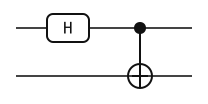
Two elements. The circuit JSON follows the Circuit JSON Conventions:
{
  "num_qubits": 2,
  "elements": [
    {"type": "gate", "gate": "H", "targets": [0]},
    {"type": "gate", "gate": "X", "targets": [1], "controls": [0], "control_configs": [true]}
  ]
}
The CNOT is encoded as an X gate with a control on qubit 0;
control_configs: [true] means the control fires on \( |1\rangle \) (active-high).
Full Bell circuit JSON.
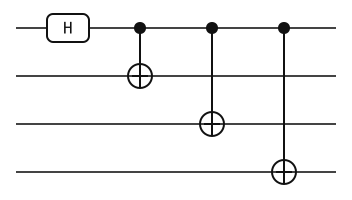
GHZ-4 reuses the same pattern with three controlled-X gates fanning out from qubit 0:
{
  "num_qubits": 4,
  "elements": [
    {"type": "gate", "gate": "H", "targets": [0]},
    {"type": "gate", "gate": "X", "targets": [1], "controls": [0], "control_configs": [true]},
    {"type": "gate", "gate": "X", "targets": [2], "controls": [0], "control_configs": [true]},
    {"type": "gate", "gate": "X", "targets": [3], "controls": [0], "control_configs": [true]}
  ]
}
Full GHZ-4 circuit JSON. The fan topology is visible in the SVG above: one Hadamard, then three controls all rooted at qubit 0.
Bit ordering callout. In yao-rs, qubit 0 is the most significant bit of the probability-array index:
probabilities[k]is the probability of the basis state whose binary label, read with enough leading zeros to fill \( n \) bits, has \( q_0 \) at the left. See bit ordering for the full convention.
Running it
Quick run (after cargo install --path yao-cli, so yao is on your PATH):
yao example bell | yao simulate - | yao probs -
Expected output:
{
  "locs": null,
  "num_qubits": 2,
  "probabilities": [
    0.5000000000000001,
    0.0,
    0.0,
    0.5000000000000001
  ]
}
For GHZ-4 the pipeline is the same with --nqubits 4:
yao example ghz --nqubits 4 | yao simulate - | yao probs -
Expected output (16 entries; only indices 0 and 15 are non-zero):
{
  "locs": null,
  "num_qubits": 4,
  "probabilities": [
    0.5000000000000001, 0.0, 0.0, 0.0,
    0.0, 0.0, 0.0, 0.0,
    0.0, 0.0, 0.0, 0.0,
    0.0, 0.0, 0.0, 0.5000000000000001
  ]
}
Regenerating this page’s artifacts (SVG diagrams and probability plots), run from the repo root:
cargo build -p yao-cli --no-default-features
target/debug/yao example bell --json --output docs/src/examples/generated/circuits/bell.json
target/debug/yao visualize docs/src/examples/generated/circuits/bell.json --output docs/src/examples/generated/svg/bell.svg
target/debug/yao simulate docs/src/examples/generated/circuits/bell.json | target/debug/yao probs - > docs/src/examples/generated/results/bell-probs.json
target/debug/yao example ghz --nqubits 4 --json --output docs/src/examples/generated/circuits/ghz4.json
target/debug/yao visualize docs/src/examples/generated/circuits/ghz4.json --output docs/src/examples/generated/svg/ghz4.svg
target/debug/yao simulate docs/src/examples/generated/circuits/ghz4.json | target/debug/yao probs - > docs/src/examples/generated/results/ghz4-probs.json
python3 scripts/plot_cli_results.py docs/src/examples/generated/results docs/src/examples/generated/plots
Interpreting the result
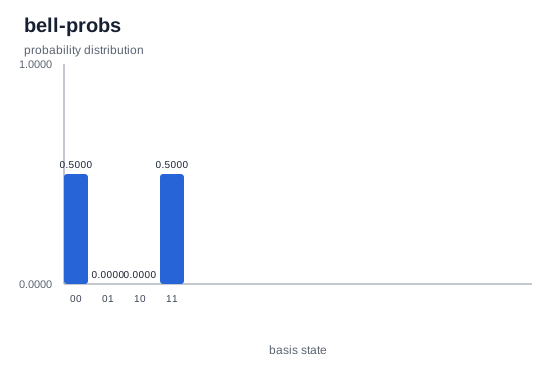
The Bell result is probabilities = [0.5, 0, 0, 0.5]. Index 0 is
\( |00\rangle \), index 3 is \( |11\rangle \); indices 1 and 2 — the
\( |01\rangle \) and \( |10\rangle \) outcomes where the two qubits
disagree — have probability zero. Measurements on the two qubits are perfectly
correlated: whichever outcome qubit 0 reports, qubit 1 reports the same bit.
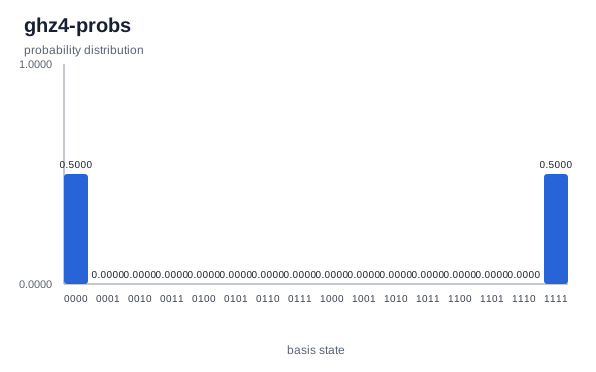
GHZ-4 has probabilities[0] = probabilities[15] = 0.5 and every one of the
fourteen middle entries is exactly zero. Under the yao-rs convention qubit 0
is the MSB, so index 15 is binary \( 1111 \) read as
\( |q_0 q_1 q_2 q_3\rangle = |1111\rangle \) — i.e. all four qubits in
\( |1\rangle \).
So on measurement the four qubits collapse together: all zeros or all ones, with
equal probability and no intermediate outcomes.
The non-classical content is this: the agreement is there before measurement, not imposed by it. Any local-hidden-variable story — each qubit carries a pre-assigned bit that the measurement reveals — must commit to a joint distribution over the four classical bit-strings. Such distributions cannot reproduce the full set of correlations \( |\Phi^+\rangle \) produces across different measurement bases; Bell’s 1964 inequality is the quantitative form of this impossibility2, and \( |\Phi^+\rangle \) violates it. GHZ sharpens the statement to an all-or-nothing contradiction3.
Variations & next steps
- Change
--nqubitsonyao example ghzto produce \( |\text{GHZ}_n\rangle \) for any \( n \geq 2 \). With \( n = 2 \) you recover the Bell state. - See Quantum Fourier Transform for the superposition+phase pattern that underlies phase estimation, and Bernstein–Vazirani for a single-shot algorithm that reads a hidden bitstring using the same H-fan structure.
- The W state \( (|100\ldots 0\rangle + |010\ldots 0\rangle + \dots + |0\ldots 01\rangle)/\sqrt{n} \) is another genuinely multipartite entangled family with correlations that survive tracing out a qubit (unlike GHZ, whose entanglement collapses into a classical mixture after one loss). It is not covered in this catalogue.
References
-
A. Einstein, B. Podolsky, and N. Rosen, “Can Quantum-Mechanical Description of Physical Reality Be Considered Complete?”, Phys. Rev. 47, 777 (1935). ↩
-
J. S. Bell, “On the Einstein–Podolsky–Rosen paradox”, Physics 1, 195 (1964). ↩ ↩2
-
D. M. Greenberger, M. A. Horne, and A. Zeilinger, “Going beyond Bell’s theorem”, in Bell’s Theorem, Quantum Theory, and Conceptions of the Universe, ed. M. Kafatos (Kluwer, 1989). ↩ ↩2
-
M. A. Nielsen and I. L. Chuang, Quantum Computation and Quantum Information, 10th Anniversary Edition (Cambridge University Press, 2010), §1.3.6 (Bell states) and §2.3 (entanglement and mixed states). ↩