Quantum Circuit Born Machine
A parameterized quantum circuit samples a probability distribution over basis states via Born’s rule; train the parameters to match a target distribution. This page lays out the ansatz — alternating single-qubit rotations and CNOT entangler rings — runs it at a fixed non-zero parameter schedule, and cross-checks the output distribution against an independent numpy simulator.
Background
The Quantum Circuit Born Machine (QCBM) is a quantum-native generative model introduced by Liu and Wang in 20181. A parameterized quantum circuit \( U(\boldsymbol\theta) \) acting on \( |0\rangle^{\otimes n} \) prepares a state whose computational-basis measurement distribution — the Born distribution — is the generative distribution. One trains \( \boldsymbol\theta \) so that this distribution matches a target \( \pi \) given as either samples or a full histogram.
Two features make the QCBM worth studying. First, it is quantum-native: there is no hand-designed score function or invertibility constraint; the model is the circuit, and sampling is a measurement. Second, with enough layers and entanglers it can represent distributions that classical autoregressive models struggle with. The cost is trainability — loss landscapes are non-convex and barren plateaus (exponentially vanishing gradients as qubit count grows) show up as depth grows2.
This page shows the canonical ansatz — rotation layers separated by CNOT entangler rings — at a fixed, deterministic parameter schedule. No training loop is invoked; the schedule is chosen only to make the output non-trivial and reproducible. Training is deferred to issue #313. For a second variational ansatz on this site, see QAOA for MaxCut; both are parameterized circuits, but QAOA optimizes an expectation value while the QCBM optimizes a distribution distance.
The math
Born’s rule defines a distribution. Given a parameterized circuit \( U(\boldsymbol\theta) \) acting on \( |0\rangle^{\otimes n} \), the output state is \( |\psi(\boldsymbol\theta)\rangle = U(\boldsymbol\theta)|0\rangle^{\otimes n} \) and the Born distribution is
$$ p_{\boldsymbol\theta}(x) ;=; |\langle x | \psi(\boldsymbol\theta)\rangle|^2, \qquad x \in {0, 1}^n. $$
Sampling from \( p_{\boldsymbol\theta} \) is a single measurement in the computational basis. Evaluating \( p_{\boldsymbol\theta}(x) \) at a specific \( x \) is easy in simulation; on hardware it is estimated from repeated samples.
Ansatz structure. A QCBM alternates rotation layers and entangler layers.
- A rotation layer applies a single-qubit rotation chain to each qubit.
Two common choices are
Rx(θ₁)·Rz(θ₂)(two parameters, sufficient for the “edge” layers where an adjacent entangler erases one redundant degree of freedom) and the three-gateRz(θ₁)·Rx(θ₂)·Rz(θ₃)triple (three parameters, an arbitrary single-qubit unitary up to a global phase). - An entangler layer is a fixed pattern of two-qubit gates. The standard choice — and the one this example uses — is a CNOT ring \( 0 \to 1 \to 2 \to \cdots \to n-1 \to 0 \).
- A depth-\( p \) ansatz has \( p+1 \) rotation layers separated by \( p \) entangler layers. Using the edge/middle split above the total parameter count is \( 4n + 3n(p-1) \) — linear in both \( n \) and \( p \).
Loss function: maximum mean discrepancy. Given a target distribution \( \pi \) over \( {0, 1}^n \) and a kernel \( K \), the MMD loss is
$$ \mathrm{MMD}^2(p_{\boldsymbol\theta}, \pi) ;=; \mathbb{E}{x,x’ \sim p{\boldsymbol\theta}} K(x, x’) - 2,\mathbb{E}{x \sim p{\boldsymbol\theta},,y \sim \pi} K(x, y) + \mathbb{E}_{y, y’ \sim \pi} K(y, y’). $$
For a characteristic kernel (e.g. a Gaussian RBF), \( \mathrm{MMD}^2 = 0 \) if and only if \( p_{\boldsymbol\theta} = \pi \). The critical property for quantum hardware is that each expectation above is estimable from samples alone — the model never needs to evaluate \( p_{\boldsymbol\theta}(x) \) explicitly.
Gradients: parameter-shift. For any rotation parameter \( \theta \) that enters as \( R_\bullet(\theta) = e^{-i\theta,\bullet/2} \) with \( \bullet \in {X, Y, Z} \), the exact gradient of any expectation value satisfies the two-point formula4
$$ \frac{\partial \langle O \rangle_{\boldsymbol\theta}}{\partial \theta} ;=; \frac{1}{2}\bigl(\langle O \rangle_{\boldsymbol\theta + \tfrac{\pi}{2}\mathbf{e}} - \langle O \rangle_{\boldsymbol\theta - \tfrac{\pi}{2}\mathbf{e}}\bigr), $$
where \( \mathbf{e} \) is the unit vector for the parameter being differentiated. The MMD loss is a linear combination of kernel expectations and inherits this rule, so unbiased gradient estimates come from two circuit evaluations per parameter.
Expressivity trade-off. Shallow circuits are easy to train but cover few distributions; deep circuits can represent more but their loss landscapes develop exponentially flat regions (barren plateaus). Choosing the right depth is a hyperparameter tune and an active research area.
The circuit

Fifty-four gates on six qubits at depth \( p = 2 \). The layout is
- First rotation layer:
Rx(θ), Rz(θ)on each of the six qubits — 12 gates, two parameters per qubit. - Entangler ring: CNOTs \( 0{\to}1, 1{\to}2, 2{\to}3, 3{\to}4, 4{\to}5, 5{\to}0 \) — 6 gates.
- Middle rotation layer:
Rz(θ), Rx(θ), Rz(θ)on each qubit — 18 gates, three parameters per qubit. - Entangler ring: identical to the first — 6 gates.
- Last rotation layer:
Rz(θ), Rx(θ)on each qubit — 12 gates, two parameters per qubit.
Total parameter count at this depth is \( 2 \cdot 6 + 3 \cdot 6 + 2 \cdot 6 = 42 \).
The script assigns angles by cycling through the fixed pool
{0.11, 0.23, 0.37, 0.51, 0.67, 0.79, 0.89} in the order the parameters
appear in the circuit, so the output is reproducible and independent of
any RNG state, but no rotation is the identity.
The JSON excerpt below shows the first rotation layer, the full first
CNOT ring, and the first Rz·Rx·Rz triple of the middle rotation layer
(15 elements out of 54). The format follows the
Circuit JSON Conventions:
{
  "num_qubits": 6,
  "elements": [
    {"type": "gate", "gate": "Rx", "targets": [0], "params": [0.11]},
    {"type": "gate", "gate": "Rz", "targets": [0], "params": [0.23]},
    {"type": "gate", "gate": "Rx", "targets": [1], "params": [0.37]},
    {"type": "gate", "gate": "Rz", "targets": [1], "params": [0.51]},
    {"type": "gate", "gate": "Rx", "targets": [2], "params": [0.67]},
    {"type": "gate", "gate": "Rz", "targets": [2], "params": [0.79]},
    {"type": "gate", "gate": "X", "targets": [1], "controls": [0]},
    {"type": "gate", "gate": "X", "targets": [2], "controls": [1]},
    {"type": "gate", "gate": "X", "targets": [3], "controls": [2]},
    {"type": "gate", "gate": "X", "targets": [4], "controls": [3]},
    {"type": "gate", "gate": "X", "targets": [5], "controls": [4]},
    {"type": "gate", "gate": "X", "targets": [0], "controls": [5]},
    {"type": "gate", "gate": "Rz", "targets": [0], "params": [0.23]},
    {"type": "gate", "gate": "Rx", "targets": [0], "params": [0.37]},
    {"type": "gate", "gate": "Rz", "targets": [0], "params": [0.51]}
  ]
}
The last three Rx·Rz pairs of the first rotation layer (qubits 3, 4, 5)
and the remaining per-qubit Rz·Rx·Rz triples of the middle layer follow
the same cycling pattern; the second entangler ring is bit-for-bit
identical to the first; and the last rotation layer reverts to the
two-gate Rz·Rx pattern. Full QCBM JSON.
Bit ordering callout. yao-rs places qubit 0 at the most significant bit of the probability-array index. Index 58 above reads \( 111010_2 \) as \( |q_0 q_1 q_2 q_3 q_4 q_5\rangle = |111010\rangle \): the leftmost bit is qubit 0. See bit ordering for the full rule.
Running it
Quick run — download the QCBM circuit JSON and simulate:
yao simulate qcbm-static-depth2.json | yao probs -
Expected output — first and last few entries of the 64-element probability vector (see the “Verifying correctness” subsection below for the full-vector invariants):
{
  "locs": null,
  "num_qubits": 6,
  "probabilities": [
    0.13268155794686642,
    0.026288662539464103,
    0.0229141740332291,
    ...
    0.08675812653019756,
    ...,
    0.04593274455545663
  ]
}
Regenerating this page’s artifacts from the repo root:
cargo build -p yao-cli --no-default-features
YAO_ARTIFACT_DIR=docs/src/examples/generated YAO_BIN=target/debug/yao bash examples/cli/qcbm_static.sh 2
python3 scripts/plot_cli_results.py docs/src/examples/generated/results docs/src/examples/generated/plots
Interpreting the result
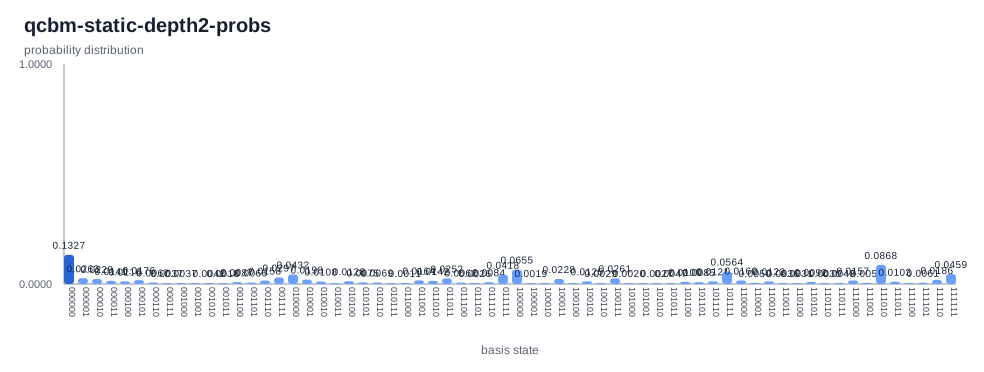
The output is a spread distribution over all 64 basis states. The top five probabilities are
| Index | Binary | Probability |
|---|---|---|
| 0 | 000000 | 0.1327 |
| 58 | 111010 | 0.0868 |
| 32 | 100000 | 0.0655 |
| 47 | 101111 | 0.0564 |
| 63 | 111111 | 0.0459 |
and the Shannon entropy is \( H(p) \approx 5.075 \) bits, versus \( \log_2 64 = 6.000 \) for the uniform distribution on 64 outcomes — so the distribution is clearly non-uniform (some basis states are favoured) but far from a delta (no single outcome dominates). This is the qualitative fingerprint of a parameterized quantum circuit away from both the identity and the trained optimum: energy has flowed out of \( |0\rangle^{\otimes 6} \) via the rotations and been redistributed by the CNOT rings.
The initial state is \( |0\rangle^{\otimes 6} \); the first rotation layer uses small angles (0.11 and 0.23 in radians on qubit 0), so most probability stays near low-Hamming-weight outputs. That is why index \( 0 \) retains the largest weight (\( 13% \)) — but it is one of 64 bins, not the whole distribution.
Verifying correctness
Two invariants should hold exactly; the measured output satisfies both.
Invariant 1: probabilities sum to 1. Summing the 64 entries of
qcbm-static-depth2-probs.json gives
\( \sum_k p_k = 1.000000000000001 \) — i.e. equal to 1 to within one
part in \( 10^{15} \). Unitarity is the whole content of this check:
every gate preserves \( |\psi| = 1 \), so Born probabilities must
sum to 1 for any circuit regardless of depth or parameters. A violation
here would flag a bug in the simulator, not in the ansatz.
Invariant 2: match against an independent simulator. Run the
reference numpy simulator from scripts/reference_simulate.py on the
same circuit JSON and compare element-by-element:
python3 scripts/reference_simulate.py \
    docs/src/examples/generated/circuits/qcbm-static-depth2.json \
    --probs > /tmp/qcbm-reference.json

python3 -c "
import json
cli = json.load(open('docs/src/examples/generated/results/qcbm-static-depth2-probs.json'))['probabilities']
ref = json.load(open('/tmp/qcbm-reference.json'))['probabilities']
print(max(abs(c - r) for c, r in zip(cli, ref)))
"
Expected output:
3.469446951953614e-18
That is machine epsilon (\( \approx 2^{-52} \approx 2.2 \times 10^{-16} \)) for complex-double arithmetic, divided by the scale of the individual probability values — a bit-for-bit match between two independent implementations. Unlike the \( \boldsymbol\theta = 0 \) special case, this test depends on every rotation angle in the ansatz and every CNOT in the entangler ring: change any one of them and the two outputs would drift apart. It verifies the layered structure end-to-end.
A trained QCBM would put mass on the bitstrings favoured by a target distribution. If the target were a truncated Gaussian over \( {0, 1, \dots, 63} \), training should reshape the probability array into a bell curve; if the target were the uniform distribution, training should flatten it across all 64 bins. The spread observed here is the fingerprint of a hand-picked parameter point — responsive to its angles, but not optimized. Replacing the fixed schedule with the output of a classical optimizer is the missing piece tracked in issue #313.
Variations & next steps
- Re-seed the parameter schedule. Patch the
thetaspool insideexamples/cli/qcbm_static.sh— any non-zero vector of 7 values will produce a different but equally verifiable distribution. The CLI-vs-reference cross-check above holds for any schedule, so use this to probe how the ansatz responds to its parameters. - Change depth. Pass
1or3to the script. Parameter count scales as \( 4n + 3n(p-1) \); expressivity scales roughly linearly in \( n \cdot p \), with barren plateaus kicking in at larger depths2. - Change entangler topology. Swap the CNOT ring for a brick-wall pattern, a nearest-neighbor line, or a random 2-local pattern. Each topology biases the accessible distributions differently; rings are a common default because they maximize connectivity under minimal gate count.
- Training loop (issue #31). Compute the MMD loss against a target distribution, evaluate gradients via parameter-shift, update via Adam or SPSA. The training harness is the missing piece this page cannot yet demonstrate end-to-end.
- Related circuits. See QAOA for MaxCut for the other variational ansatz on this site — same hand-picked parameter treatment, different cost function. See Entangled States for the H + CNOT fan that underlies the simplest possible “QCBM” — a depth-0 ansatz on two qubits is exactly a Bell pair.
References
-
J.-G. Liu and L. Wang, “Differentiable Learning of Quantum Circuit Born Machines”, Phys. Rev. A 98, 062324 (2018); arXiv:1804.04168. ↩
-
J. R. McClean, S. Boixo, V. N. Smelyanskiy, R. Babbush, and H. Neven, “Barren plateaus in quantum neural network training landscapes”, Nat. Commun. 9, 4812 (2018); arXiv:1803.11173. ↩ ↩2
-
yao-rs issue #31, “Parameter-optimization loop for variational examples”. Tracks the planned training harness for QAOA, QCBM, and VQE-style workflows. ↩ ↩2
-
K. Mitarai, M. Negoro, M. Kitagawa, and K. Fujii, “Quantum circuit learning”, Phys. Rev. A 98, 032309 (2018); arXiv:1803.00745. The same two-term rule for Pauli generators is re-derived and extended in M. Schuld, V. Bergholm, C. Gogolin, J. Izaac, and N. Killoran, “Evaluating analytic gradients on quantum hardware”, Phys. Rev. A 99, 032331 (2019); arXiv:1811.11184. ↩